

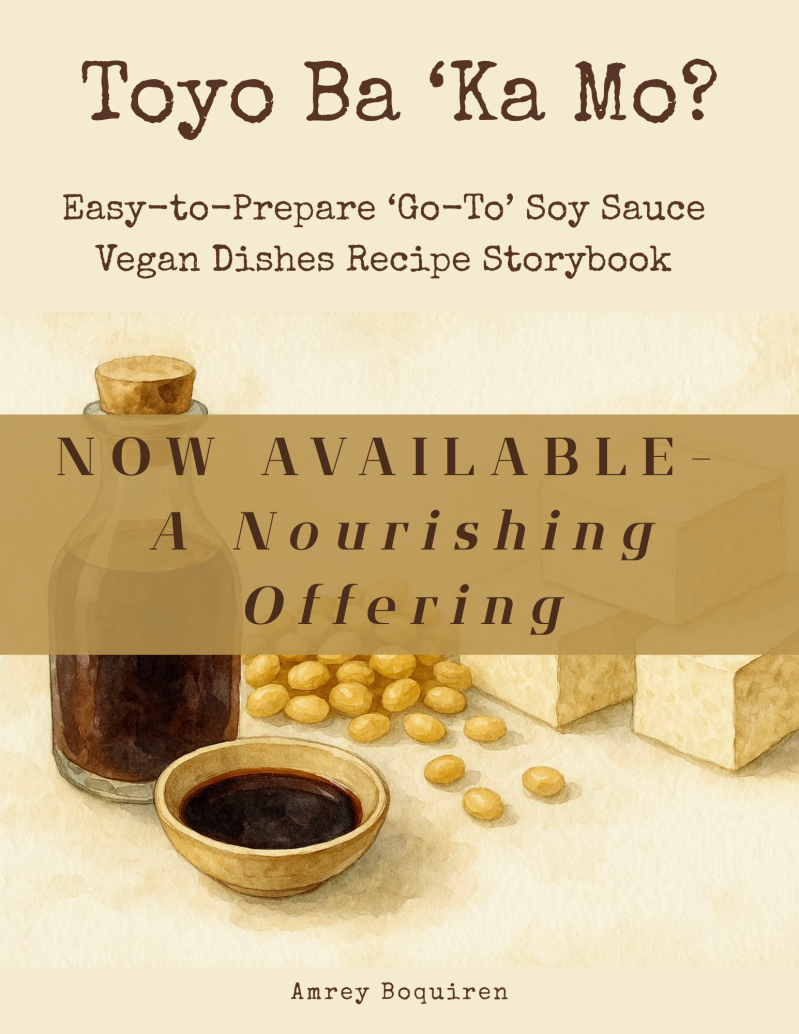
People often ask me where the title Toyo Ba ’Ka Mo?™ came from.
At first glance, it sounds playful — even teasing.
In everyday Filipino conversation, “Toyo ba ’ka mo?” can mean:
Are you being moody? Are you okay? What’s going on with you?
But beneath that casual question lives something much deeper.
Toyo as flavour — and as feeling
Toyo is soy sauce — a staple in many Filipino kitchens.
It’s salty, grounding, familiar. It’s often the first thing you reach for when you want something to taste like home.
But toyo is also a word we use to describe emotional shifts — moods, sensitivity, moments of inner turbulence.
That dual meaning stayed with me.
In the kitchen, soy sauce transforms dishes.
In life, our “toyo moments” — our moods, our fluctuations, our quirks — also shape who we become.
This book was born from that understanding.
A title that asks, not accuses
Toyo Ba ’Ka Mo? is not meant as a judgment.
It’s a gentle check-in.
It’s the kind of question asked by someone who cares:
Are you alright?
What’s happening inside you?
Do you need nourishment — not just food, but understanding?
The title invites curiosity, not defence.
Cooking as reflection
The recipes in this book are simple, plant-based, and familiar — but they are also intentional.
Each dish was cooked during moments of:
- quiet reflection
- emotional processing
- everyday living in between work, caregiving, and rest
Cooking became a way to listen to myself, to my body, to the rhythm of life.
In that sense, Toyo Ba ’Ka Mo?™ is not just about soy sauce.
It’s about awareness.
It’s about honouring where you are — emotionally and physically — and choosing nourishment anyway.
A book that meets you where you are
This storybook doesn’t ask you to be perfect.
It doesn’t ask you to be “zen” or “healed.”
It simply asks:
Where are you right now?
And then it offers food — as comfort, as culture, as nourishment.
Because sometimes, that’s where healing begins.


Add comment
Comments